
IPTV technology is legal in the USA; whether a service is legal depends on whether it holds licences for the channels it distributes, and unauthorised redistribution infringes US copyright law. Enforcement has focused on operators rather than viewers. On safety, this page sets out how Tivimate says it delivers credentials, handles payment and collects personal data. Tivimate IPTV is this site's own service and does not publish its rights agreements, so read its terms and check local rules before you subscribe.

Questions about IPTV safety and legality are among the most common ones US viewers ask — and for good reason. The IPTV market contains a wide range of services, and understanding the difference between licensed and unlicensed streaming matters for US consumers.
Is IPTV Legal in the USA?
IPTV (Internet Protocol Television) is simply a method of delivering television content over the internet — the same technology used by YouTube TV, Sling TV and Netflix. As a technology, IPTV is entirely legal.
The legal question is about content licensing. A service that holds proper licences for the channels and content it distributes operates legally. A service that redistributes broadcast signals without authorisation — effectively pirating premium sports or other paid channels — infringes US copyright law.
US enforcement has focused on the operators of unlicensed services, not primarily on end users — but using an unlicensed service carries its own risks: unreliable streams, no customer support, sudden shutdowns, and potential data security issues.
What US Law Says About Streaming
US copyright law (Title 17 of the US Code) gives rights holders the exclusive right to perform their programmes publicly, which includes streaming them (17 U.S.C. §106). Wilful infringement for commercial gain can be prosecuted as a crime under 17 U.S.C. §506.
The Protecting Lawful Streaming Act of 2020 went further, making it a felony to run a commercial streaming service built primarily on unauthorized content. It targets operators, not individual viewers. Rights holders also use the DMCA's notice-and-takedown system (17 U.S.C. §512) to pull pirate streams offline, and the Alliance for Creativity and Entertainment (ACE), a coalition of major studios and streaming companies, investigates unlicensed IPTV operators and works with law enforcement to shut them down.
In Canada the equivalent law is the Copyright Act (R.S.C. 1985, c. C-42), and enforcement there has likewise focused on operators, including court orders requiring internet providers to block pirate IPTV services.
How Can You Tell Whether an IPTV Provider Is Licensed?
You usually cannot prove it from the outside, but you can look for signals that a provider holds the rights to what it streams. Licensed services tend to share a few traits:
- A named company behind the service, with a registered address and published terms
- Apps listed in the official stores of major TV platforms under the company's own name
- Channel line-ups and prices that track the deals broadcasters publicly announce
- Payment through mainstream processors and billing that names the company on your statement
The absence of these signals does not prove a service is unlicensed, but it does mean you cannot confirm that it is licensed. That applies to every provider you look at, including this site's own service — which is why we suggest reading the terms and checking local rules rather than taking anyone's word for it.
Is Tivimate Safe to Use?
From a personal data and security perspective, Tivimate operates with straightforward security practices:
- Credentials are delivered via WhatsApp — a standard end-to-end encrypted messaging platform
- No unnecessary personal information is collected beyond what is required to set up your account
- Payment is handled securely via standard payment processors; card details are not stored by Tivimate
- 24/7 WhatsApp support means any account issues can be resolved quickly
Security practices are only half of the question. Tivimate IPTV is this site's own service, and we do not publish the rights agreements behind its channel list, so we are not going to tell you it is licensed. Read our Terms of Service and refund and cancellation terms, use the free trial, and check the rules where you live before you subscribe — the same checks you should run on any provider.

What Does "Safe" Mean for an IPTV Subscriber?
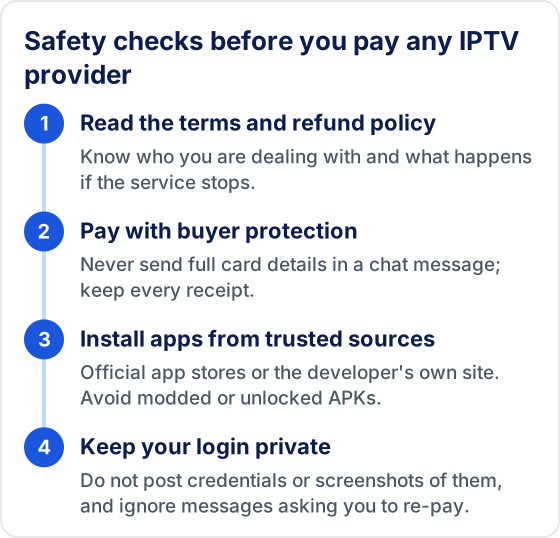
For a viewer, safety comes down to four practical areas: who you pay and how, what you install, how you protect your login, and what data you hand over. Each one can be checked before you spend any money.
- Payment hygiene: use a payment method that gives you buyer protection where possible, never type full card details into a chat window, and keep every receipt and confirmation message.
- Malware-free installs: install player apps only from an official app store or the developer's own site. "Modded", "premium unlocked" or repackaged APKs from unknown sites are the most common way malware reaches streaming devices.
- Account security: your server URL, username and password are the whole account. Do not post them online, crop them out of screenshots, and ignore unexpected messages asking you to pay again or "re-verify" your card.
- Privacy: a service needs very little to set you up. Be cautious of any provider that asks for identity documents or more personal details than a contact and a payment.
How Tivimate Compares to Free Piracy Services
| Factor | Tivimate | Free Piracy Streams |
|---|---|---|
| Reliability | Paid, maintained servers | Frequent outages |
| Picture quality | HD/4K UHD | Variable SD/HD, buffering |
| Customer support | 24/7 WhatsApp | None |
| Data security | Standard encrypted delivery | Unknown — potential malware risk |
| Continuity | Published terms and refund policy | May disappear overnight |
| EPG | Full EPG included | Usually absent |
Common Misconceptions About IPTV Legality
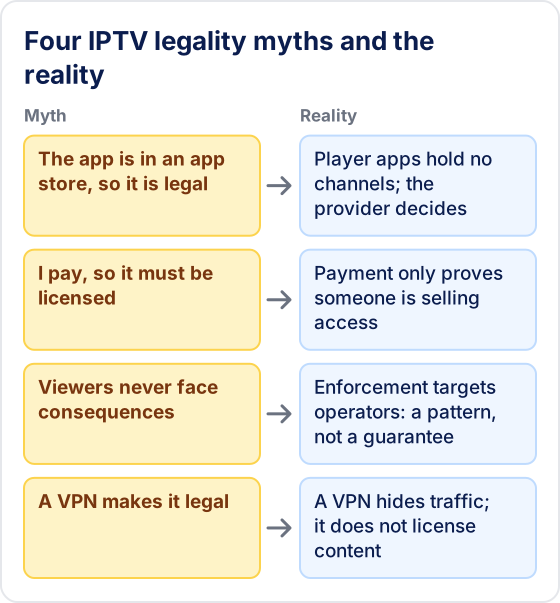
Several beliefs about IPTV come up again and again, and most of them are wrong in a way that matters:
- "If the app is in an app store, the service is legal." Player apps such as TiviMate or IPTV Smarters contain no channels; they only play the playlist you load. The app’s availability tells you nothing about the provider whose streams you put into it.
- "If I pay for it, it must be licensed." Payment proves only that someone is selling access. Unlicensed services charge too.
- "Viewers can never face consequences." Enforcement has focused on operators, but that is a pattern, not a guarantee, and laws differ between states and countries.
- "A VPN makes it legal." A VPN hides your traffic from your internet provider. It does not change whether the content is licensed.
None of this is legal advice. If you need a firm answer for your situation, check the rules where you live or ask a lawyer.
The Practical Answer for US Viewers
For US viewers looking for a straightforward, reliable IPTV service with full sports and entertainment coverage, Tivimate offers a free 24-hour trial — no credit card required — so you can assess the service quality before committing. Plans start at $19.99/month, less than a typical cable TV package.

Frequently Asked Questions
Is IPTV legal in the USA?
IPTV as a technology is legal. The legality depends entirely on whether the service has licensed the content it streams. Services that hold the rights to their channels are lawful. Services that redistribute broadcast content without authorisation infringe copyright law.
Is Tivimate safe to use?
Tivimate operates securely. Customer details are handled confidentially, credentials are delivered via encrypted WhatsApp, and the service does not require unnecessary personal information. Payment is handled securely without storing card details.
Can I be prosecuted for using an IPTV service in the USA?
US enforcement has historically focused on operators of unlicensed services rather than end users. However, using an unlicensed service carries practical risks: loss of service, potential data exposure, and poor picture quality — quite apart from any legal considerations.
Is the TiviMate app itself legal?
Yes. TiviMate is an IPTV player app made by Armobsoft FZE, and it contains no channels of its own — it plays the playlist you add from a provider. This site is not the app's developer. Whether what you watch through it is legal depends on the provider, not the player.
Does using a VPN make an IPTV service legal?
No. A VPN encrypts your connection and hides it from your internet provider, which can help privacy on public networks. It does not give you or the provider any rights to the content, so the legal position is the same with or without it.
Try Tivimate IPTV
55,000+ live channels · 180,000+ movies and series · 4K on selected channels · No contract · From $19.99/month